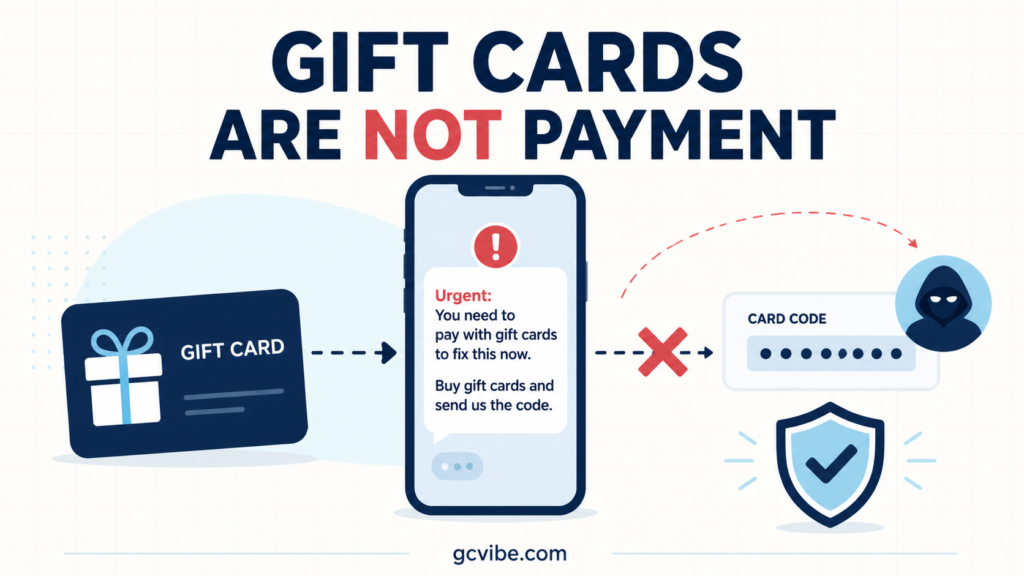
The simplest way to recognize a gift card payment scam is this: someone tells you to buy a gift card and send the card number, redemption code or PIN. It does not become legitimate because the message mentions a government office, a company director, a family emergency, a prize or an online relationship.
Two official warnings in August 2026 show why this rule still matters. On August 3, the Hawaiʻi Department of the Attorney General reported a text-message scheme that impersonated the attorney general and requested gift card information. On August 20, Western Australia’s Commissioner for Consumer Protection warned about gift cards being requested in romance, government, workplace and investment scams.
These notices describe different stories, but the payment pattern is the same. The scammer creates trust or fear, demands speed, controls how the card is bought and then asks for the code. This guide explains the red flags, a safe verification method and the actions to take if you have already shared a code.
Short answer: Gift cards are designed to buy goods or services from the brand that issued them. They are not a normal way to pay a government agency, settle a workplace expense, fix a computer, release a prize or help a stranger in an emergency.
Why gift card scams are in the news again
Gift card scams are not one fixed script. Impersonation is the delivery method, while the card code is the payment rail.
In the August 3 case, the name of a senior government official was used to make a text request appear authoritative. The later Western Australian warning highlighted longer confidence-building schemes, including romance fraud, as well as messages pretending to come from a business, government agency or manager.
Nigeria faces the same broader social-engineering conditions. The Nigeria Computer Emergency Response Team has highlighted phishing through email, SMS, WhatsApp and other social platforms that imitates reputable organizations. A message can display a familiar name, logo or profile photograph without coming from that person or organization.
The important lesson is not to memorize one scam story. Learn the transaction pattern: unexpected contact + urgency or secrecy + gift card purchase + request for the code.
The 9 clearest red flags
1. A gift card is presented as payment
The U.S. Federal Trade Commission states that legitimate businesses and government agencies do not demand gift cards as payment. Apple likewise says its gift cards are for Apple products and services, while Google says Play gift cards should only be used for the appropriate brand.
If the card is supposedly needed for a fine, tax, fee, debt, computer repair, delivery charge or account verification, stop.
2. The request is urgent
Scammers often set an artificial deadline: act in ten minutes, stay on the phone, or face arrest, job loss, service disconnection or a missed opportunity. Urgency prevents a second opinion. A real process can be verified through an official channel.
3. You are told to keep it secret
The message may say not to tell a cashier, colleague, bank employee or family member. Secrecy isolates the target from anyone likely to challenge the story.
4. The sender chooses the brand and shop
A scammer may specify Apple, Google Play, Steam, Amazon or another card, then direct you to a particular retailer. Some ask for several smaller purchases or send the victim to multiple stores. Those instructions are designed to complete the transfer while avoiding questions.
5. They ask for a photo, number or PIN
The physical card does not protect the balance once its usable credentials are exposed. A clear photograph may reveal everything needed to redeem it. Never send the back of a card, its scratch-off area, a receipt containing sensitive details or a redemption screen to an unverified person.
6. Authority is used instead of verifiable procedure
Official-looking names, uniforms, email signatures and caller ID can be copied or spoofed. A genuine title is not proof that the person contacting you holds it.
7. The story changes when you question it
You may be transferred to a supposed supervisor, told that a bank transfer is suddenly unavailable or warned that verification will cancel the process. These are pressure tactics, not normal safeguards.
8. A relationship is used to bypass caution
The sender may pose as a romantic partner, relative, colleague or senior manager. The FTC warns that criminals can even use voice cloning in family-emergency schemes. A familiar voice or writing style should not replace independent verification.
9. A refund, prize or investment requires an advance gift card
A genuine refund does not require a new payment first. A legitimate prize does not require card codes to release winnings. An investment platform should not require retail gift cards as deposits or tax payments.
Scam request or legitimate gift? Use this comparison
| What happens | Legitimate gift-card use | Likely payment scam |
|---|---|---|
| Who chooses the card | You choose a suitable gift | The sender dictates a brand and amount |
| Where value is used | With the issuing brand or its stated services | To pay a person, agency, employer or unrelated business |
| Treatment of the code | The recipient redeems it privately | You are told to photograph or read the code aloud |
| Time pressure | No emergency is attached | Immediate action is demanded |
| Verification | The purpose remains valid through an official channel | The sender resists independent contact |
| Secrecy | Normal gift giving may be a surprise | You are told not to speak to anyone |
One red flag is enough to pause. You do not need to prove who the scammer is before refusing the transaction.
A 5-minute verification routine
When a message feels urgent, use a separate channel rather than replying to the contact details it provides.
- Stop the conversation. Do not buy another card or reveal partial information.
- Find the real contact yourself. Use an official website, a number printed on a statement, or a contact already saved before the message arrived.
- Ask a precise question. For example: “Did your office ask me at 2:15 p.m. to buy three gift cards?”
- Verify a family or workplace request independently. Call the person on a known number or contact another relative or colleague.
- Reject gift-card payment. Even if part of the story is true, use only the organization’s documented payment method.
Do not use the phone number, link or support account supplied in the suspicious message. That can return you to the same scam operation.
What to do if you already shared a card code
Act quickly, but understand that recovery is not guaranteed. The balance may already have been redeemed or transferred.
| Step | What to do | Why it matters |
|---|---|---|
| 1 | End contact and do not send more cards | A second request is often framed as a recovery fee or final payment |
| 2 | Keep the card, packaging and receipt | The issuer may need the serial number, purchase time, shop and amount |
| 3 | Contact the issuing brand through its official site or the number printed on the card | The issuer can check status and may be able to freeze unspent value |
| 4 | Say clearly that the card was used in a scam and ask about recovery | A normal balance inquiry may not reach the correct fraud process |
| 5 | Save messages, usernames, phone numbers and transaction times | A chronological record helps support and incident reporting |
| 6 | Secure affected accounts | Change reused passwords and enable multi-factor authentication if a fake login page or remote-access tool was involved |
| 7 | Report the incident to the appropriate authority | Reports help connect related campaigns and preserve evidence |
For Nigerian users, ngCERT provides an individual cyber-incident reporting form. If money, identity documents or account access are involved, also contact the relevant financial institution and local law-enforcement channel. Users elsewhere should use their national fraud or cybercrime reporting service; U.S. consumers can use the FTC’s reporting guidance.
When contacting support, share evidence only through the issuer’s verified process. Never post a full code, PIN or receipt publicly while asking for help.
What the card issuer may ask for
Prepare the information you still have before contacting support:
- the card brand and denomination;
- the card or serial number requested by the official support form;
- the original purchase receipt;
- the shop, date and approximate time of purchase;
- whether the code was shared, and when;
- any redemption error or case number already received.
Do not alter screenshots or delete the conversation. Keep originals and make a separate redacted copy if you need to show the event to someone outside the official investigation.
If the card has not been redeemed, support may be able to restrict it. If it has been redeemed, the issuer may investigate but might not be able to return the value. Anyone who promises guaranteed recovery for an upfront fee may be attempting a second scam.
How to buy gift cards more safely
Payment scams begin with a request, but cards can also be compromised before purchase. The FTC advises buyers to inspect physical cards for removed protective stickers, exposed PIN areas or other signs of tampering.
- Buy from a retailer you know or the brand’s official channel.
- Where available and appropriate, consider paying by credit card; depending on your issuer and local rules, it may provide additional dispute protections.
- Check the packaging and scratch-off area before paying.
- Confirm that the card shown on the receipt matches the card you received.
- Keep the card and receipt after giving or redeeming it.
- Send a digital card only to the intended recipient’s verified address.
- Treat unexpected “discounted bulk cards” from informal sellers as high risk.
These checks cannot make every transaction risk-free, but they preserve evidence and reduce avoidable exposure.
Frequently asked questions
Can a scammer use a gift card without holding the physical card?
Yes. For many cards, the usable card number and PIN or redemption code are enough. A photograph or copied code can therefore transfer control of the value even while you keep the plastic card.
Is a message from a real executive or government account safe?
Not necessarily. Accounts can be compromised, display names can be copied and phone numbers can be spoofed. Verify the request through an independently sourced official channel.
Can I recover money after sending a code?
Possibly, but there is no guarantee. Contact the issuer immediately, state that the card was involved in fraud, ask whether the remaining value can be frozen and keep the card and receipt.
Should I send the receipt to someone offering recovery help?
Only submit evidence through a verified issuer, bank, law-enforcement or government reporting process. A receipt may contain information useful to a second scammer.
What if the caller sounds exactly like someone I know?
End the call and contact that person using a number you already trust. Voice cloning and account compromise mean familiarity alone is not verification.
Is it safe if I am buying the card for myself?
Buying a card for your own use can be legitimate. The danger appears when another person directs the purchase and asks for the code, or when an unofficial seller supplies a compromised card.
The rule worth remembering
Recent warnings use different examples, but the safest response remains simple: gift cards are for spending with the issuing brand or giving to someone you know—not for paying an authority, employer, stranger or emergency caller.
Pause, verify through a separate channel and never reveal the code under pressure. If the code is already exposed, contact the issuer first, preserve the evidence and report the incident without publishing sensitive card details.
Official sources
- Hawaiʻi Department of the Attorney General: gift card scam impersonating the attorney general (August 3, 2026)
- Western Australia Commissioner for Consumer Protection: Don’t let gift cards become a scammer’s payday (August 20, 2026)
- Federal Trade Commission: Avoiding and reporting gift card scams
- Nigeria Computer Emergency Response Team
- Google Play Help: Buy, send and receive gift cards
- Apple Gift Card safety notice